First Swarm of the Season Captured

Got a call yesterday via the Maine State Beekeepers Association Swarm Team Hotline:  (207) 619-4BEE for a local swarm and went to grab it at dusk with my friend JCF.

Thank goodness the homeowners gave us a shout as they had received two bits of bad advice –  a local exterminator was going to charge them $350 to spray the bees with poison (dumb idea – see: Why not Kill Them, by prominent beekeeper Cindy Bee – yes, that is her REAL name) and a local beekeeper (who really should know better) wasn’t patient enough to hear them out and find out where the bees really were (hanging off of the house) and only listened to the first few panicked words  “the bees are IN my house” (they were not) and sent her to the exterminators.  Very lazy way to deal with a “civilian” who is understandably afraid of 20,000 stinging insects on their home.  Swarming honey bees are not going to attack anybody, and it is the responsibility of a beekeeper to help walk folks through that.  As a matter of fact. part of the EAS Master Beekeeper requirements are “can present this information to the beekeeping and non-beekeeping public in a detailed, accurate, clear and authoritative manner.” and “knowledge and ability to communicate effectively to both beekeepers and public”.

Anyway, off my soap box.

The swarm was under the eaves of a log-style home (see red circle) and fortunately they had a sturdy ladder on hand, so we didn’t have to drag one over.
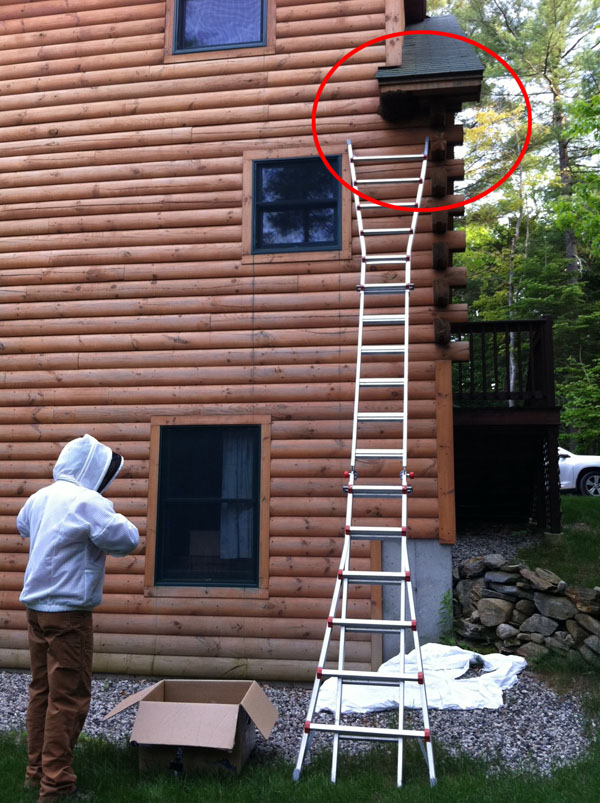
Up the Ladder to Capture the First Swarm of the Season
Big J. suiting up. Then up the ladder we go to capture the first swarm of the season

I am guessing it was around 4 or 5 pounds of our little flying friends – they were very docile.  Just sprayed them with a little sugar water and scooped them into the “lucky” swarm box (see the video of it in action from last year).
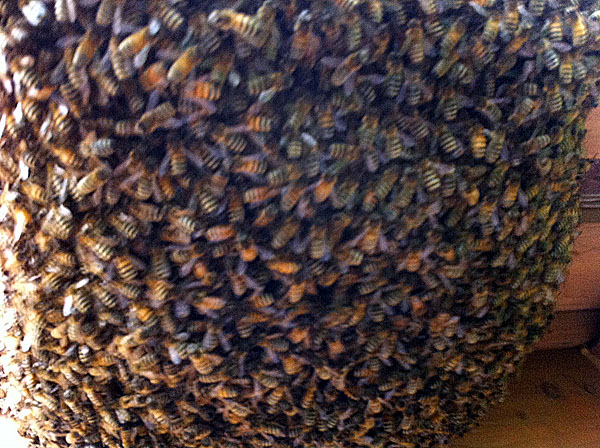
Close up of the Swarm

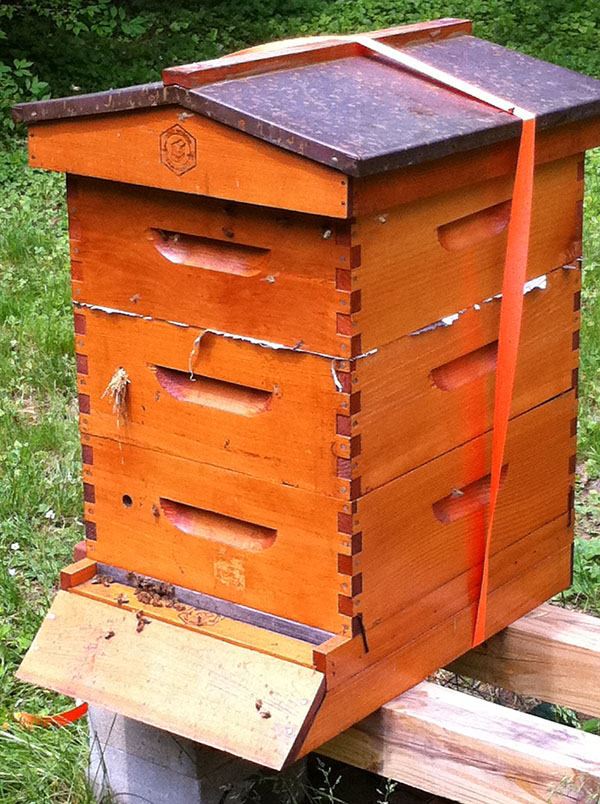
Combined them with a very weak hive in the apiary by putting a sheet of newspaper between two supers and letting them chew through (the top super also had a hole for them to fly, and let the stray bees come in) overnight.  Went to check at lunch today and there was lots of activity around the entrance and lots of happy bees. Will go in tomorrow to check on progress and perhaps even add another super.

All-in-all a successful bee rescue.
Happy Combined Hive (note the newspaper sticking out)

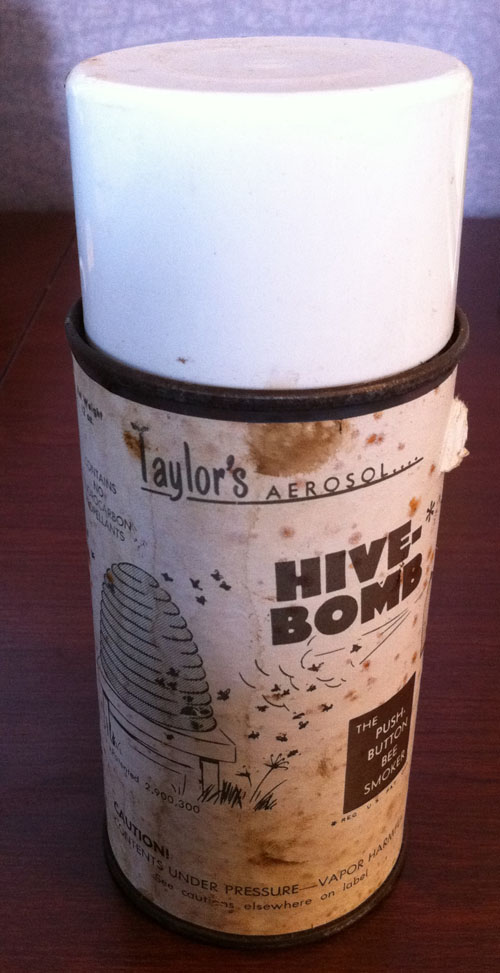
Taylor’s Aerosol Hive Bomb

How about this for a wacky beekeeping product idea: Taylor’s Aerosol Hive Bomb “The Push-Button Bee Smoker”?  An aerosol can with fake smoke to calm your hives down before inspecting.

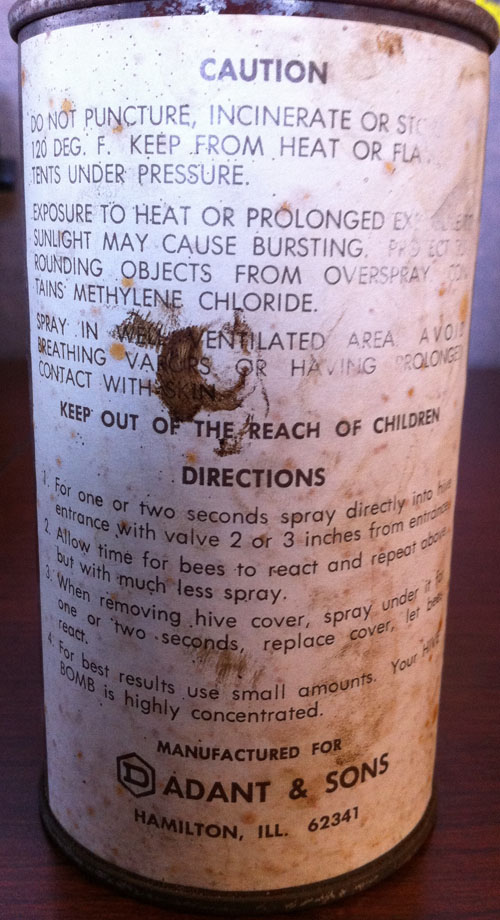
Well, it is real.  It was manufactured for Dadant & Sons (a formidable beekeeping supply company) I am guessing in the 1970’s (anybody have an old catalogue they could verify it in?) judging from the label and where I found it in my fathers beekeeping supplies.

Taylor's Aerosol Hive Bomb
Taylor's Aerosol Hive Bomb - Manufactured for Dadant

One look at the caution label on the back gives me even further pause as to why it would have been produced and vexes me as to why my father would have purchased it.    But the can feels pretty full, so I am guessing it was just a failed experiment – and old-time version of this goofy thing.  Learn how to light a smoker folks, it really isn’t that hard.

Taylor's Aerosol Hive Bomb Warning Label

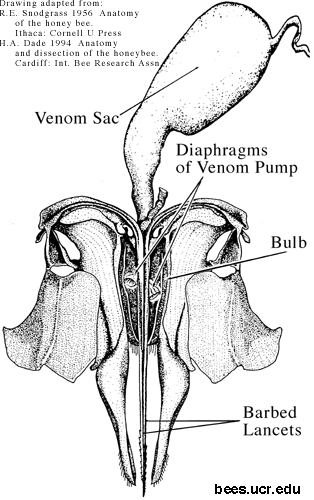
Removing bee stings – speed matters, method doesn’t

from: http://bees.ucr.edu/stings.html
(expanded from an article published 1996 in The Lancet 348:301-302)

Summary

Removing bee stings - speed matters, method doesn't

Background Conventional advice on immediate treatment of honey bee stings has emphasized that the sting should be scraped off, never pinched. The morphology of the sting suggested no basis for this, and such advice is likely to slow down removal of the sting.

Methods The response to honey bee stings was assayed with a measurement of the size of the resulting sting weal. Injection of known quantities of venom demonstrated that this is a good measure of envenomization.

Findings Weal size, and thus envenomization, increased as the time from stinging to removal of the sting increased, even within a few seconds. There was no difference in the response to stings which were scraped or pinched off after two seconds.

Interpretation These data suggest that advice to patients on the immediate treatment of bee stings should emphasize quick removal, without concern regarding the method of remova